
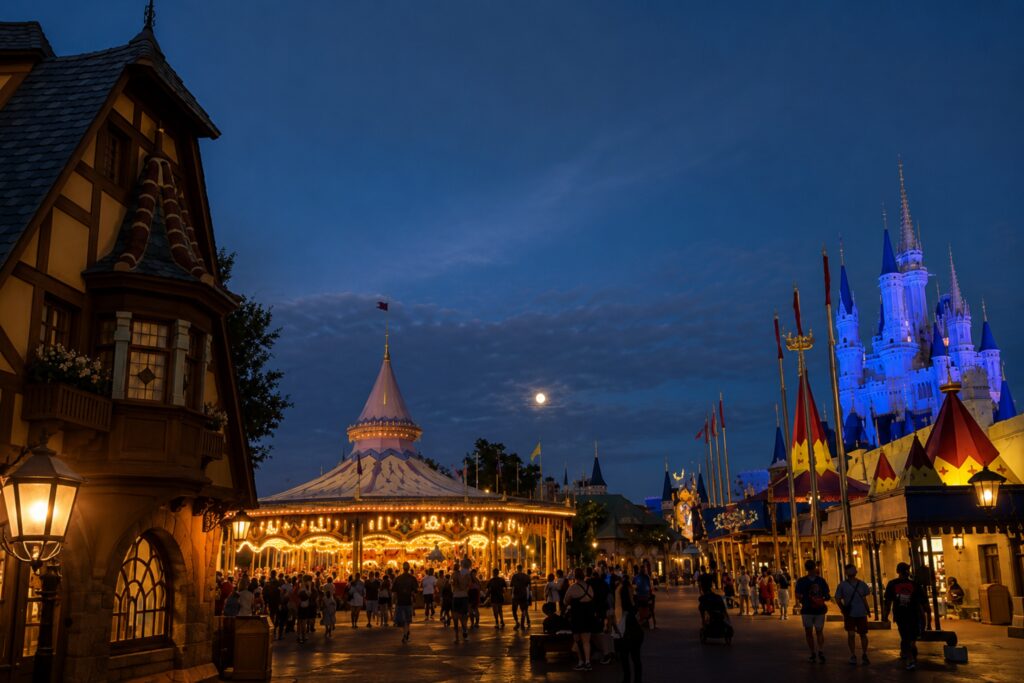
Every place has an hour that seems to reveal its true character. Cities become quieter after commuters have gone home. Beaches change as the last families gather their towels and the tide begins reclaiming the shoreline. Even neighborhoods that feel ordinary during the afternoon somehow become more intimate after porch lights begin to glow and conversations drift through open windows. Disney is no different. Although most guests associate the parks with castles, attractions, and fireworks, many leave believing that the most memorable part of the day happened after the sun disappeared. They rarely stop to ask why.
The obvious explanation is that Disney is simply more beautiful at night. Main Street is illuminated by warm lanterns instead of direct sunlight. The castle reflects shades of blue and gold that photographs struggle to capture. Music seems to float more gently through the streets, while every storefront window appears to invite guests to slow down and linger. None of those observations are wrong, yet they describe only what has changed around us. They do not explain the quieter transformation taking place within us. The evening feels different because, somewhere between daylight and darkness, our relationship with time begins to change.
Throughout the afternoon, most people experience Disney with remarkable efficiency. They compare wait times, refresh mobile apps, study maps, and calculate whether one more attraction can fit before dinner. Even families who promised themselves they would simply enjoy the day often find themselves negotiating schedules that grow increasingly complicated as the hours pass. Disney does not create this instinct. It merely exposes something that already exists inside us. Given enough opportunities, most people become convinced that a successful day is measured by how much they accomplished rather than how deeply they experienced it.
That instinct follows us far beyond the entrance gates of a theme park. Modern life quietly teaches us that value is found in productivity, and productivity almost always depends upon moving toward whatever comes next. Calendars reward efficiency. Careers reward output. Even vacations have become projects to optimize, complete with itineraries, reservations, and carefully organized lists of experiences that must somehow fit into a finite number of hours. It should not surprise us that we bring those habits into places we hoped might help us escape them. We often arrive searching for rest while carrying the very mindset that makes rest so difficult to find.
As daylight begins to fade, however, something subtle starts to happen. The realization settles in that there is no longer enough time to experience everything, and the impossible task of creating the perfect day quietly slips away. At first glance, this might seem disappointing, but the opposite is usually true. The pressure to optimize begins dissolving because there is no longer any reason to pretend the checklist can be completed. The urgency that governed the afternoon slowly loses its authority, leaving behind something we rarely experience in everyday life: permission to simply be where we already are.
That change in perspective alters what we notice. Details that had been present all day suddenly become impossible to ignore. The glow of a window on Main Street feels warmer than it did only an hour before. A child laughing while chasing bubbles becomes more interesting than the attraction waiting across the park. The sound of the train echoing through Town Square somehow seems richer, even though it has been making the same journey since morning. None of these moments are new. They simply become visible because our attention is no longer consumed by the next destination.
This may be Disney’s greatest achievement, and it has remarkably little to do with technology or engineering. Disney does not manufacture wonder nearly as much as it creates environments capable of rewarding attention. The slower someone moves, the more the place seems willing to reveal. Architectural details emerge from the background. Music that once faded into the noise becomes part of the atmosphere. Conversations feel warmer, while familiar pathways begin carrying an unexpected sense of nostalgia before the vacation has even ended. The environment remains unchanged, but the person walking through it has become more available to experience it.
Beautiful places have always possessed this ability. A mountain overlook at sunset, a quiet bookstore on a rainy afternoon, or an empty beach after dinner all seem to invite the same response. We often assume these places create peace, but perhaps they simply remove enough distraction for peace to become noticeable again. Beauty has never forced us to slow down. It has simply offered an invitation that busy minds rarely accept until something else persuades them to stop rushing.
Children understand this instinct almost effortlessly. They rarely arrive with carefully constructed itineraries or expectations about maximizing the value of every hour. Instead, they become fascinated by puddles reflecting colorful lights, passing trains, balloons floating overhead, or music drifting through the evening air. Adults often smile at this behavior without recognizing that children are demonstrating a way of seeing the world that many of us gradually abandoned. They experience places through attention rather than efficiency, which may explain why their memories are often built from moments adults barely noticed.
Years later, very few people remember exactly how many attractions they experienced on a particular Disney vacation. They struggle to recall which reservation was hardest to secure or whether they crossed every item from their carefully prepared list. Instead, memory returns to moments that seemed almost insignificant while they were unfolding. It remembers walking toward the exit beneath glowing lanterns while a tired child rested on someone’s shoulder. It remembers sharing an ice cream with no destination in mind or lingering on Main Street because nobody was quite ready for the evening to end. Those moments survive because they were never competing with tomorrow. They belonged entirely to the present.
Perhaps that is why Disney feels different at night. The lighting certainly helps, and the atmosphere is undeniably beautiful, but those qualities are only part of a much larger story. Evening quietly reminds us that time cannot be managed forever and that every meaningful day eventually reaches its conclusion. Once we stop trying to improve the experience, we finally become capable of receiving it. We notice what was always there, waiting patiently beneath the noise of our own urgency.
That realization extends far beyond Disney. Every ordinary evening offers the same invitation if we are willing to accept it. A walk through the neighborhood after dinner, a conversation on the porch as daylight disappears, or the simple act of lingering at the table after everyone has finished eating all carry the same quiet possibility. Life becomes memorable not because extraordinary things happen every day, but because ordinary moments occasionally receive our complete attention. Disney feels different at night because, for a little while, it helps us remember how to live that way, and perhaps the greatest souvenir we can bring home is not a photograph or a keepsake but the willingness to notice that the same invitation has been waiting for us all along.
