
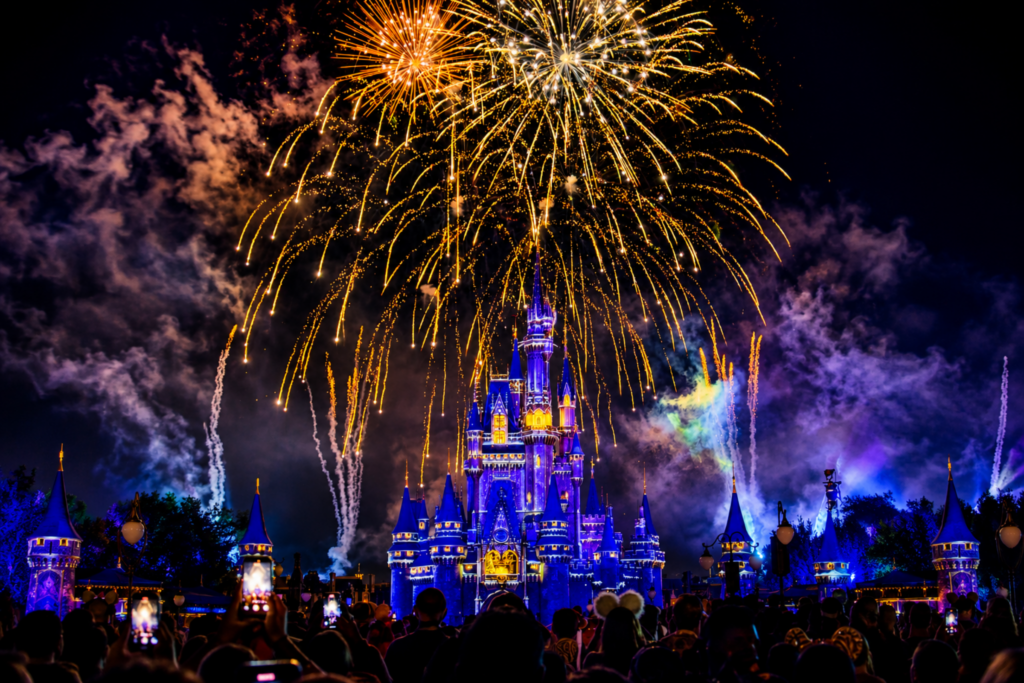
There is a point in a Disney day when the place begins to change. The sun disappears behind the buildings, the heat finally loosens its grip, and thousands of lights that were nearly invisible an hour earlier begin to define the landscape. It is easy to explain our affection for Disney after dark as a response to atmosphere. The parks are beautiful at night. But that doesn’t quite explain why the final hours of a Disney day so often become the ones we remember most.
By then, much of what we planned has already happened. The reservation is over, the rides have been ridden, the backpack is a disaster, and someone who insisted they weren’t tired is asleep in the stroller. There is less left to accomplish, and that seems to change the way we experience the place. We stop looking so insistently for what comes next and begin noticing what is already around us.
Some of it was there all day.
1. The details that disappear in daylight
Darkness should make a place harder to see, yet Disney often becomes more detailed at night. During the day, everything competes for attention at once. After sunset, lighting begins making choices for us. A window above a storefront glows. A lantern illuminates a path. Reflections appear across water. Architecture that blended into the larger landscape becomes distinct.
The details aren’t new. What changes is our ability to see them.
2. The sounds underneath the noise
The same thing happens with sound. Music that had been playing unnoticed all afternoon becomes unmistakable. Water, distant conversations and transportation sounds emerge from what had previously registered as general park noise.
Disney hasn’t suddenly become quiet. We have become less occupied. Earlier, our attention was consumed by the information required to move through the day: where we were going, how long we had, what everyone needed. Once some of that urgency disappears, we discover how much of the experience had been sitting quietly beneath it.
3. The places that weren’t supposed to be destinations
During the day, a pathway is often something we use to get somewhere else. At night, the same walkway along the water can become somewhere we are reluctant to leave. We sit because our feet hurt and discover a view we hadn’t thought to look for. We take the longer route back because, for once, arriving quickly doesn’t matter very much.
Disney is filled with these in-between spaces, and they become easier to appreciate once we stop treating every minute as transportation to something more important. The attraction may have brought us into the park, but it doesn’t necessarily become the part we carry home.
4. The ordinary lives happening around us
Night also seems to make individual families emerge from the crowd. You notice the father carrying a child who has grown almost too large to carry, the grandparents waiting with popcorn while everyone else rides something again, the couple sitting quietly while their children sleep nearby.
None of it is remarkable, which may be precisely why it can feel so affecting. These aren’t performances. They are ordinary family moments happening inside an extraordinary place.
Sometimes watching them makes our own lives visible again. The person beside us stops being simply the person we’ve spent twelve hours navigating a theme park with. This is our husband at this age, our mother on this trip, our child with this particular face and voice. Familiarity usually makes those things harder to see. For a moment, somehow, we see them.
5. The moments nobody planned
We put considerable effort into creating experiences we hope will become memories, but memory remains stubbornly uninterested in our itinerary. The dinner we reserved months ahead may eventually blur while the walk afterward remains strangely clear. We forget exactly what we rode but remember what our child said while we were waiting for the boat. The carefully posed photograph tells us less about the trip than the blurry one taken when everyone was exhausted.
Planning can create the conditions for a meaningful experience. It cannot decide which part will matter.
Often, the moment that survives is the one that happened after we stopped trying to make one.
6. The day behind us
For most of a Disney day, our attention points forward. What are we doing next? How much time do we have? Can we fit one more thing in?
Late in the evening, the questions change. What was your favorite thing today? Did you see her face when that happened? Remember what she said earlier?
We are still living the day, but we have already begun remembering it.
There is less ahead of us now than behind us, and perhaps that is why the final hours acquire a quality the afternoon didn’t have. The day that felt almost endless that morning has developed edges.
7. The fact that it is almost over
This may be the thing we notice most clearly after dark, even if we never consciously name it.
The day is running out.
Soon someone will suggest heading toward the exit. There will be a final walk, a final look behind us, perhaps one last attempt to squeeze something in. The experience that felt abundant twelve hours ago has become finite.
And suddenly we are very good at paying attention.
This is where Disney after dark becomes interesting beyond Disney, because ordinary life rarely gives us such obvious cues.
There is no lighting change when a season of childhood is nearly over. Nothing announces the last time a child will mispronounce a word, ask to be picked up, or crawl into your bed in the morning. We don’t know when we’re having the final ordinary dinner belonging to a particular version of our family. Most endings reveal themselves only after they have happened.
The moments we eventually miss rarely looked important while we were living them. They looked like bath time and school mornings, grocery runs and conversations in the car. We assumed there would be another one because, almost always, there was.
Until there wasn’t.
The answer isn’t to become sentimental about every moment or to document our lives more aggressively. A photograph can preserve what something looked like without preserving what it felt like to be there. We can collect enormous amounts of evidence that our lives happened while still moving through much of them without really noticing.
The more interesting possibility is that attention can be practiced before hindsight makes it unavoidable.
That idea is at the heart of A Life Remembered. It isn’t about preserving everything or filling life with experiences worthy of photographing. It is about becoming better at recognizing what matters while it still belongs to the present—understanding what makes certain moments stay, and creating more room to actually inhabit the life we may someday wish we could visit again.
Perhaps that is part of what Disney gives us after dark. The changing light makes time visible. The day grows smaller, our plans fall away, and for a little while we stop looking for the next thing.
We notice where we are.
The remarkable thing is that it was there all day.
