
If Walt Disney were here today — not the myth, not the caricature, but the man — I don’t think he would start by talking about parks, or movies, or even creativity. I think he would ask how tired we are. How fast everything feels. Whether we remember the last time we stood somewhere beautiful without reaching for proof that we were there.
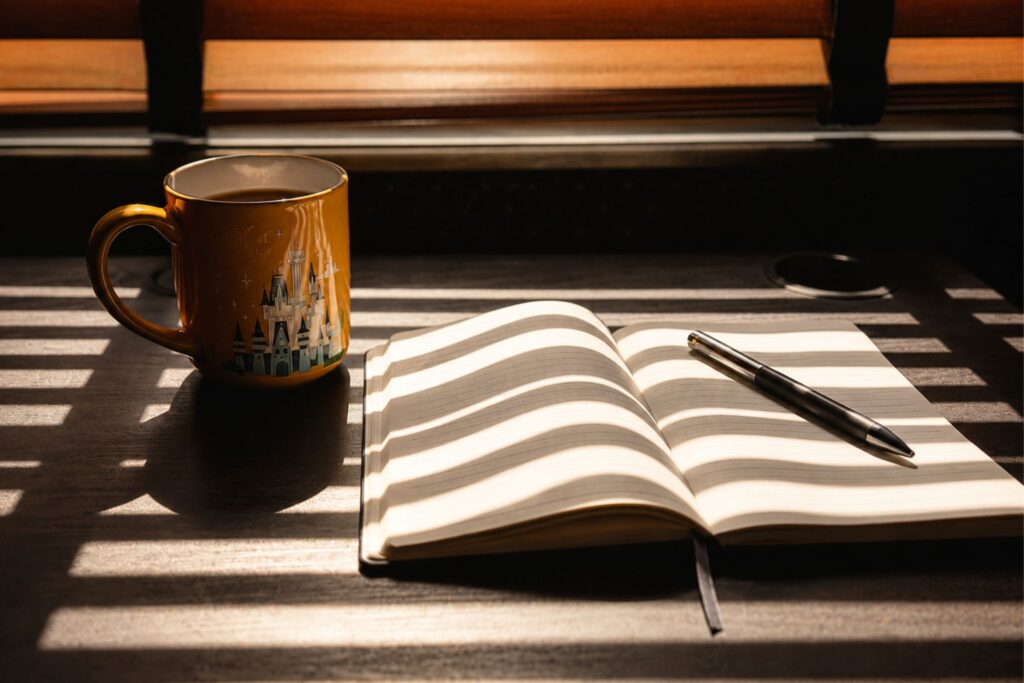
I imagine him sitting across from us at a small table, coffee cooling between his hands, listening more than talking at first. Walt was, after all, a listener. An observer. Someone who noticed how people moved through the world before he tried to change it.
And eventually, gently, he’d say something like: “You know, none of this was ever meant to feel rushed.”
Because if there is one thing Walt understood deeply — in his work, and in his life — it was pacing. Not productivity. Not optimization. Pacing. The rhythm of how a person moves through a day, through a space, through a memory.
Walt didn’t believe that more was better. He believed that enough, carefully considered, was everything.
When people talk about Disney now, they often talk about spectacle. Big moments. Iconic visuals. But that was never where Walt’s attention lingered. His real fascination was in what happened between the big moments — the walk from one place to another, the way music softened as you turned a corner, the pause before something revealed itself. He cared about how people arrived somewhere, and just as much about how they left.
That’s not accidental. That’s philosophy.
Walt believed that life — and the spaces we build inside it — should feel welcoming rather than overwhelming. He wanted people to feel held by an experience, not chased through it. That belief showed up everywhere, from how early Disneyland pathways curved instead of running straight, to how sightlines were intentionally broken so that nothing revealed itself all at once.
He understood something we’ve largely forgotten: that anticipation is part of pleasure, and that memory needs room to settle.
Disney Dally exists because of that belief.
Not because of the brand Disney became, and certainly not because of the corporate entity that exists now — The Walt Disney Company is a different conversation entirely — but because of the human philosophy Walt operated from. A belief that life should be designed with care, and that people deserve experiences that respect their emotional bandwidth.
Walt didn’t design for adrenaline. He designed for reassurance.
He wanted families to feel safe lingering. He wanted adults to feel allowed to delight without embarrassment. He wanted children to feel wonder without chaos. And underlying all of it was a quiet conviction that joy is not something you force — it’s something you make space for.
That idea applies far beyond theme parks.
It applies to how we travel.
Walt would have hated the way we treat travel now — the way we turn it into a checklist, a race, a performance. He would have questioned why we move so quickly through places we once dreamed of seeing, why we measure success by how much we fit in instead of how deeply we felt anything at all.
He understood that the most meaningful parts of a trip are rarely the headline moments. They’re the mornings when nothing is scheduled yet. The evenings when the day winds down slowly. The walks back, the conversations that drift, the feeling of being somewhere without needing to do anything with it.
Travel, to Walt, was never about conquering a place. It was about entering it respectfully.
And the same was true of space.
Walt thought deeply about how environments shape behavior. How light changes mood. How sound can calm or agitate. How scale can either invite or intimidate. He believed that spaces should guide people gently, without instruction. That a well-designed environment doesn’t tell you how to feel — it makes the feeling possible.
That philosophy lives at the heart of Disney Dally’s approach to space. Whether we’re talking about a room, a resort, a street, or a quiet corner of a park, the question is always the same: Does this space allow someone to exhale?
And then there’s life itself — the part Walt never separated from his work.
Despite the mythology, Walt was not obsessed with constant motion. He valued reflection. He believed in endings. He understood that a day needs a proper close if it’s going to be remembered kindly. He knew that exhaustion dulls joy, and that wonder requires a certain amount of rest.
If he were sitting with us now, I think he’d be gently concerned by how little room we leave for that. How often we confuse busyness with fullness. How rarely we allow a moment to stand on its own without documenting it, sharing it, or moving past it too quickly.
Disney Dally is, in many ways, a response to that concern.
It’s an invitation to live a little more like Walt designed — not in imitation, but in alignment. To pace our days with intention. To travel with curiosity instead of urgency. To shape our spaces so they support who we are becoming, not just what we own. To remember that a meaningful life isn’t built from highlights alone, but from the quiet moments we chose to stay present for.
Walt once said that Disneyland would never be finished, as long as there was imagination left in the world. I think the deeper truth is that living well is never finished either — it’s something we return to, again and again, adjusting our pace, refining our attention, remembering what matters.
If he were here, coffee long gone cold, I imagine he’d smile softly and say something like: “You don’t have to do so much. You just have to care.”
And then he’d stand up, straighten his jacket, and leave us with that thought — trusting us, as he always did, to carry it forward in our own way.
That’s what Disney Dally is doing.
Not preserving a brand.
Preserving a way of noticing.
And in a world that moves as fast as this one does, that might be the most radical design choice of all.
