
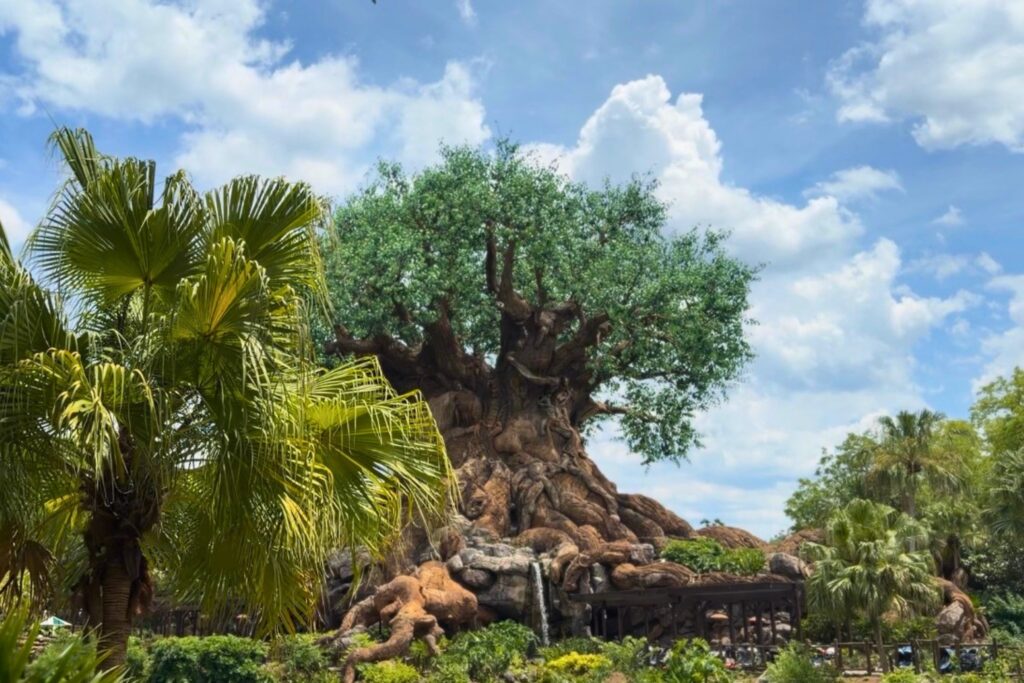
Disney’s Animal Kingdom may be the quietest park Disney has ever built, though most people never experience it that way.
They move through it quickly, the same way people move through most vacations now — checking wait times while walking, mobile ordering lunch before they are hungry, treating the day like something to complete efficiently rather than something to actually inhabit. And because of that, they often leave remembering the attractions while missing the thing that makes Animal Kingdom feel so different from every other park on property.
The park was never designed around constant momentum.
It was designed around atmosphere.
You feel it most clearly in the places people pass through too quickly. The pathways behind the Tree of Life, for example, where the crowds thin out just enough for the soundscape to change. Water replaces noise there. The air feels heavier with vegetation. People instinctively slow down, even if only for a moment, because the space quietly removes the pressure to move. Most guests treat the Discovery Island Trails as a hidden shortcut when, in reality, they are one of the emotional centers of the entire park. The carvings in the tree become more noticeable there, not because they are suddenly larger or more impressive, but because you are finally standing still long enough to actually see them.
That is what Animal Kingdom does better than almost anywhere else at Walt Disney World Resort. It creates environments that gently interrupt urgency.
The Maharajah Jungle Trek in Asia does this beautifully in the late afternoon, particularly near the aviary and temple ruins, where the filtered light and weathered stone begin to feel less like themed design and more like memory. Disney intentionally built age into these spaces — cracked walls, faded murals, overgrown pathways — and the effect is subtle but important. The park does not feel polished in the way most modern spaces do. It feels lived in. Time exists there. The environment breathes differently because of it.
Even Harambe changes character as the day slows down. In the early morning it feels energetic and alive, but near dusk the entire village softens. The music drifts through the streets instead of announcing itself. The warm light against the worn buildings makes the area feel almost cinematic in a way that has nothing to do with spectacle. Standing there in the evening, watching people wander without rushing, you begin to realize how rare it has become to experience a place designed primarily around texture, pacing, and emotional atmosphere rather than constant stimulation.
That may be why so many people describe Animal Kingdom as “different” without fully being able to explain why.
The park understands something most modern entertainment spaces have forgotten: people are not always craving more noise, more activity, or more efficiency. Often, they are simply craving relief. Relief from speed. Relief from performance. Relief from the exhausting feeling that every moment has to justify itself.
Animal Kingdom quietly resists that.
Some of the most meaningful moments there come from doing almost nothing at all — sitting near the water in Asia while the prayer flags move overhead, wandering Gorilla Falls without looking at the time, lingering beneath the canopy on a trail that leads nowhere important. None of those moments photograph particularly well. None of them look impressive on an itinerary. And yet those are often the moments that stay with people longest after they return home.
Not because they were exciting.
Because they felt real.
