
A few weeks from now, I probably won’t remember where we were headed.
I know that sounds strange to admit, especially because getting there required planning. There were reservations to make, bags to pack, schedules to coordinate, and all the small decisions that accompany any family outing. Like most adults, I spent far more time thinking about where we were going than I did about what might happen along the way.
Yet when I think back on the afternoon now, none of those details feel particularly important.
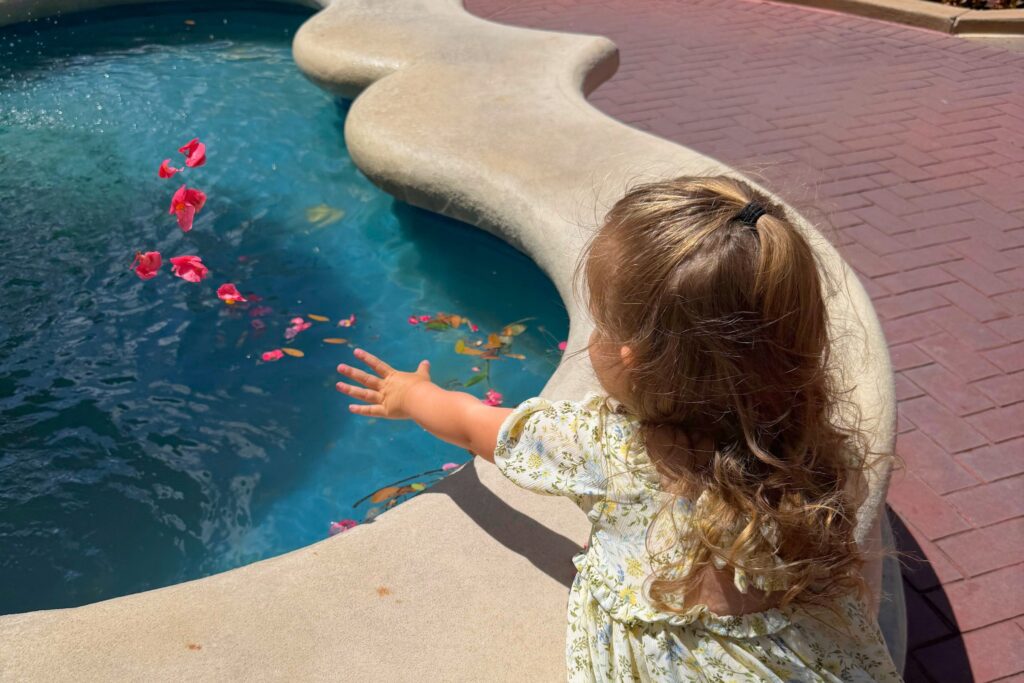
What I remember is a fountain.
Not because it was remarkable. In fact, it was the sort of thing most adults would hardly notice. It sat where fountains often sit, offering a pleasant place to pause before continuing on to whatever destination had originally justified the trip. People passed by without much thought. A few glanced at it. Most kept walking.
A small child, however, saw something entirely different.
She found a handful of flower petals and began dropping them into the water one at a time. There was no goal, no lesson, and certainly no urgency. Each petal landed with the same quiet fascination as the one before it. She watched them drift. She gathered more. She dropped them again. Time seemed to stretch in the way it often does around children, who have not yet learned that every moment is supposed to be measured against what comes next.
For nearly twenty minutes, nothing happened.
Or at least that is how an adult might describe it.
No attraction was experienced. No destination was reached. No item was crossed off a list. If someone had asked us afterward what we accomplished during that stretch of time, the honest answer would have been very little.
And yet I suspect that if either of us remembers that day years from now, it will be that moment that returns first.
The older I get, the more I notice this pattern repeating itself. The moments that remain are rarely the moments I would have predicted while they were happening. Memory seems remarkably uninterested in importance. It does not carefully preserve the things that cost the most money, required the most effort, or occupied the most space on a calendar. Instead, it drifts toward moments that felt complete in themselves, moments that asked nothing more of us than our attention.
This may be one of the reasons children often remember different things than adults do.
Adults tend to organize experiences around destinations. We remember the trip, the celebration, the achievement, or the milestone. We remember the thing we were trying to accomplish. Children often seem to remember something smaller tucked inside those larger events. They remember a particular seat on a train. They remember feeding birds near a lake. They remember a joke told while waiting in line. They remember a certain snack, a certain smell, or the way sunlight looked coming through a window.
For years, I assumed this was simply because children notice unusual things. Now I wonder if the opposite might be true. Perhaps children notice the things that matter and adults become distracted by the things we believe should matter.
As we get older, our attention becomes crowded. We carry responsibilities, deadlines, obligations, and expectations. Even during moments that are meant to be enjoyable, part of our attention remains occupied elsewhere. We are thinking about what comes next, whether everything is going according to plan, whether everyone is having a good time, and whether the experience is living up to what we hoped it would be.
Children are often free from that burden.
They are not evaluating the experience while it is happening. They are simply experiencing it.
A train ride is not transportation.
It is a train ride.
A fountain is not a place to pass by on the way to something more important.
It is the most interesting thing in the world for the next fifteen minutes.
A garden is not scenery.
It is a place to explore.
Watching a child move through the world can feel like watching someone visit a familiar place for the first time. Details that disappeared into the background years ago suddenly return. Things that seem ordinary become worthy of attention again. The pace slows. The edges sharpen. The world feels larger than it did a moment before.
I suspect this is one reason so many parents describe childhood as simultaneously exhausting and magical. Children continually redirect our attention toward things we have stopped seeing. They interrupt our efficiency. They complicate our schedules. They cause us to arrive late, linger longer, and abandon plans altogether. Yet in doing so, they occasionally reveal parts of life that were quietly disappearing behind our routines.
This becomes especially noticeable during travel.
Adults often approach vacations with a long list of things they hope to remember. We want the perfect photograph. The unforgettable meal. The iconic view. The experience that justifies the time and expense required to get there. We build entire itineraries around these moments because we assume they will become the highlights of the trip.
Sometimes they do.
More often, however, the memories that remain seem almost accidental.
Years later, we find ourselves talking about the unexpected conversation at breakfast, the walk back to the hotel after sunset, the thunderstorm that changed the afternoon’s plans, or the small discovery that no guidebook ever mentioned. The trip itself becomes difficult to summarize, while a handful of seemingly insignificant moments remain perfectly clear.
Perhaps memory has always worked this way.
Perhaps memory is less interested in documenting our lives than it is in preserving evidence of what truly captured our attention. It gathers fragments rather than summaries. It saves sensations rather than itineraries. It preserves the feeling of an experience long after the details have begun to fade.
When viewed through that lens, many of childhood’s strongest memories begin to make sense.
A family tradition repeated every year.
The smell of a particular meal.
A grandparent’s porch.
A bedtime routine.
The route home from school.
The way holiday decorations looked in a certain room.
None of these moments seem particularly extraordinary while they are happening. In fact, their power may come from their ordinariness. They become meaningful precisely because they are experienced again and again, woven quietly into the fabric of everyday life until they become inseparable from the feeling of home, family, belonging, or love.
Adults often worry about creating memorable moments for children, and understandably so. Childhood moves quickly. There is an awareness, sometimes a painful one, that these years are temporary. We want to make the most of them. We want our children to have experiences worth remembering.
Yet perhaps the pressure we place on ourselves is occasionally misplaced.
The goal is not to manufacture memories.
The goal is to create a life in which meaningful moments have room to occur.
Those moments may happen during a vacation, but they are just as likely to happen on an ordinary Tuesday. They may emerge from a special event, but they are just as likely to appear during a walk, a meal, a conversation, or a quiet pause that nobody planned.
This is one of the reasons I find myself returning so often to the idea of attention. We tend to think of memory as something that happens afterward, something that arrives years later when we look back. In reality, memory begins much earlier. It begins with what we notice. It begins with where we linger. It begins with the things we decide, consciously or unconsciously, are worthy of our presence.
Children seem to understand this naturally.
They give themselves permission to be fully absorbed by small things. They allow ordinary moments to become complete experiences. They do not hurry toward meaning because they have not yet learned that meaning is supposed to be somewhere else.
Perhaps that is why they often remember different things than we do.
Or perhaps they are simply remembering the same day more accurately.
Years from now, I may not remember where we were headed when we stopped beside that fountain. I may not remember what we accomplished afterward, what we ate for dinner, or how the rest of the afternoon unfolded.
But I suspect I will remember the flower petals.
I will remember watching them drift across the surface of the water while a child stood nearby, completely absorbed by a moment that asked nothing of her except her attention.
And the older I get, the more I think that may have been the most important part of the day.
